
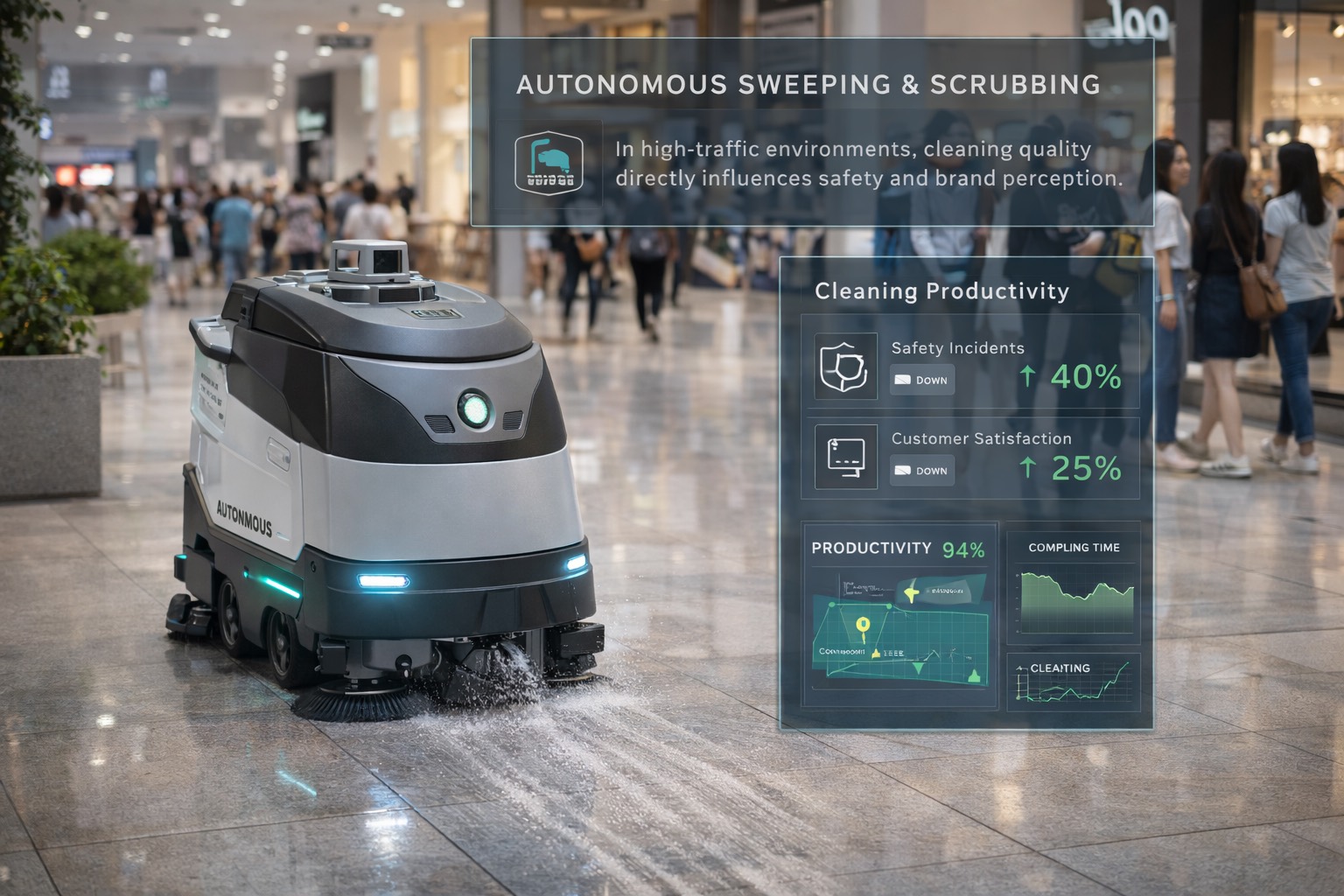
Large facilities rarely have a perfect window for cleaning. There is always a delivery in progress, a corridor that must remain open, a shift change, or a customer-facing area that cannot be blocked. In that reality, cleanliness becomes more than presentation. It becomes a safety and operational issue, and it must be managed with the same discipline as other building services.
This is where autonomous sweeping and scrubbing starts to make practical sense. The goal is not to “replace” cleaning staff. The goal is to keep standards consistent in wide areas, at predictable intervals, and during inconvenient hours, without relying on overtime as a permanent strategy.
Consider the typical pressure points in commercial and industrial environments. Shopping centers have peak traffic hours and strict expectations for presentation. Warehouses have constant movement and dust accumulation. Transport hubs face continuous foot traffic and safety risk from wet or dirty floors. Business parks and campuses have large corridors and common areas that must look maintained without interrupting operations.
In these sites, cleaning is often done in two extremes. Either teams rush through a schedule to cover the entire building, or they focus on urgent problems and postpone broad coverage. Both approaches create inefficiency. The first one wastes labor on areas that do not need attention, while missing areas that do. The second one leads to inconsistent standards and higher risk, because issues are handled only when they become visible.
The most effective strategy is often responsiveness rather than intensity. A predictable route, run frequently, often delivers better real-world results than a perfect deep clean performed occasionally. Autonomous cleaners support that strategy by making coverage a continuous service instead of a periodic event.
Because routes are repeatable, a facility can define exactly what “clean” means in terms of frequency and coverage. Operators can schedule runs during low-traffic windows, target zones that need attention more often, and keep the rest of the facility within an acceptable baseline without constant supervision.
Operating during inconvenient hours is one of the clearest advantages. Night shifts and early mornings are common cleaning windows, but they are also difficult to staff and difficult to standardize across multiple sites. Autonomous systems can operate at these times with consistent performance. They can avoid conflicts with deliveries, security rounds, or tenant activity, and they can return to charging without requiring a person to “babysit” the cycle.
There is also an operational reliability angle. Facilities that require a “ready by” time every day, such as retail spaces, lobbies, or shared corridors, benefit from automation because it reduces variability. Staff absence or shift gaps do not immediately translate into missed coverage. Managers gain more control over outcomes, and the cleaning team can focus on detailed work where human judgment and adaptability are essential.
Automation also improves accountability. Cleaning is notoriously hard to measure. A manager can see whether an area looks clean, but it is difficult to prove when it was cleaned, how thoroughly, and whether it was missed. Modern autonomous platforms can provide route logs, coverage records, and operational status information. That documentation helps internal teams, and it also improves contract management when cleaning is outsourced. Service quality becomes measurable, not assumed.
None of this removes the need for people. Facilities still require waste handling, spot cleaning, detail work, and rapid response to spills and unexpected conditions. What autonomy changes is how the routine surface coverage is delivered. It becomes predictable. It becomes schedulable. And it becomes easier to standardize across large areas or multiple sites.
In practice, successful deployments usually start with a simple operational plan: which zones require frequent coverage, what hours are available, where docking should be placed, and how reporting should be handled. Floor material and surface conditions also matter. A short assessment and a coverage target are typically enough to determine whether the approach will deliver real value.
AIXINTO provides autonomous cleaning and scrubbing solutions designed for commercial and industrial environments. The emphasis is not only on the machine, but on fitting the workflow: routes, timing, safety procedures, and reporting aligned with the facility’s service standards. When that alignment is in place, the result is cleaner floors, fewer safety incidents, and a cleaning operation that is easier to manage and easier to scale.